
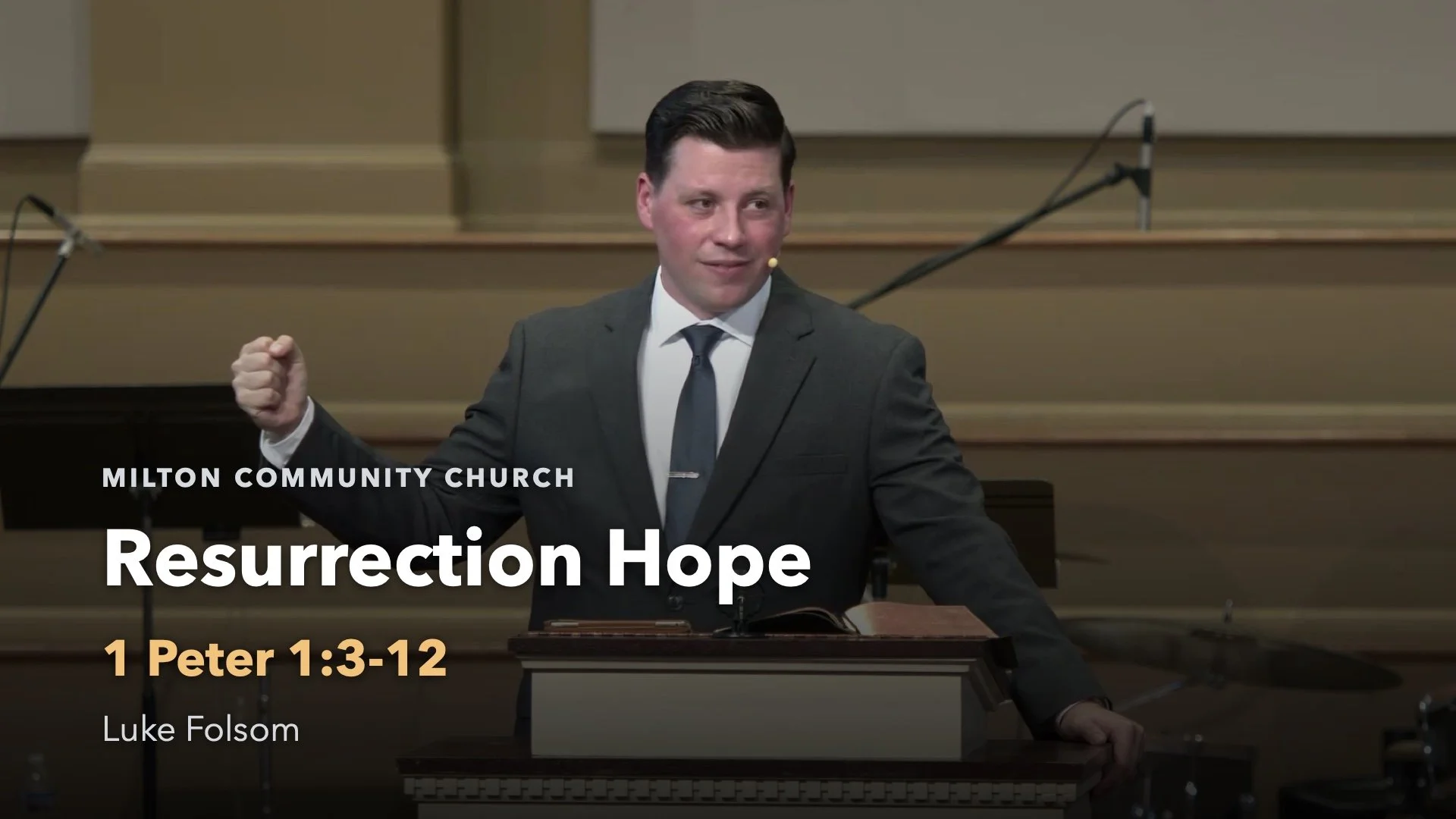
Introduction and Gratitude
Well, good morning, church. Good morning. I want to just begin by extending our gratefulness and thankfulness to you, our home church and our church family, for how well you've cared for us this past year. So many of you walked with us through a difficult season for our family.
As you know, this church sent us out to the mission field several years ago, an exciting time. And then we had to come back home off the mission field last year due to a medical care leave, due to some family health issues. And so this past year, just figuring out if we could go back to the field or not, or if the Lord was going to lead us to a new ministry opportunity, you have walked with us every step of the way. Even when there was a little bit of maybe even shame and guilt for having to come off the mission field, you did not make us feel that way at all. You welcomed us with open arms and you cared for us and walked with us through that. And we are just so thankful to you to be able to come back to this home church and to rest and to heal and to feel cared for.
We found out earlier this summer we wouldn't be able to return to the mission field. We began to search and to seek for a new ministry opportunity. And the Lord opened up this role, associate pastor role, at Edgefield Church in Nashville. And so we've got to visit them a couple times already. And yes, they are voting on me as we speak. And so I would appreciate prayers for that. I might get a text while I'm preaching. So my notifications are muted, though, so I won't see it. But we will let you know. If that goes well, we'll be moving up there later this month.
And so we just appreciate prayers, continued prayers for our family and a new transition, new ministry, new state, new city, all of these things and things you know that come with transitions. But we are ready and excited to see what the Lord will do. So we appreciate that. Even though, yeah, plans didn't go the way we thought they would, we know that we serve a good God who is faithful and we trust and we believe with all of our hearts that he is working all things together for good. He's working all things together for our good and for his glory. And that he's able to do far more abundantly than we could ask or think.
And so I'm so thankful for this opportunity to preach from God's word this morning, one last time before we move, Lord willing, if that vote goes well. When Pastor Nathan asked me to preach and I began to consider what I could bring to you during this special occasion, my mind went to 1 Peter chapter 1. So if you have your Bibles, you can go ahead and turn there to 1 Peter chapter 1. And this is a chapter that has held us these past few years as we've walked through some difficult seasons. As we've seen the resurrection hope we have, as we've held on to this living hope that we have granted to us by the resurrection of our Lord Jesus Christ.
So as we dig in this passage this morning, not necessarily my goal to teach you anything new, but hopefully to remind you of some things and to encourage you and to share what the Lord has used to encourage us. We'll do that from 1 Peter chapter 1, verses 3 through 12. And so if you would please stand in honor of God and the reading of his word this morning.
1 Peter chapter 1, verses 3 through 12. Blessed be the God and Father of our Lord Jesus Christ. According to his great mercy, he has caused us to be born again to a living hope through the resurrection of Jesus Christ from the dead, to an inheritance that is imperishable, undefiled, and unfading, kept in heaven for you who by God's power are being guarded through faith for a salvation ready to be revealed in the last time. In this you rejoice. Though now, for a little while, if necessary, you have been grieved by various trials. So that the tested genuineness of your faith, more precious than gold that perishes though it is tested by fire, may be found to result in praise and glory and honor at the revelation of Jesus Christ. Though you have not seen him, you love him. Though you do not now see him, you believe in him and rejoice with joy that is inexpressible and filled with glory, obtaining the outcome of your faith, the salvation of your souls. Concerning the salvation, the prophets who prophesied about the grace that was to be yours searched and inquired carefully, inquiring what person or time the Spirit of Christ in them was indicating when he predicted the sufferings of Christ and the subsequent glories.
"It was revealed to them that they were serving not themselves, but you, and the things that have now been announced to you through those who preach the good news to you by the Holy Spirit sent from heaven, things into which angels long to look." This is the word of the Lord.
You may be seated. Join with me in prayer.
God our Father, blessed be your name. Blessed be your name in all the earth. God, we have gathered together this morning to praise you not on our own initiative, but on yours. According to your great mercy, you have caused us to be born again. While we were dead in our sins and trespasses, you have made us alive in Christ Jesus.
We praise you, O God, for our salvation. Salvation wrought totally and entirely by you, not by anything that we have done. By grace alone, through faith alone, in Christ alone. We praise you, O God, for the plan of salvation. That before eternity began, you chose those to whom you would set your love upon, not based on any foreseen merit in them, but based totally on your grace and mercy.
You sent your son to be born of a virgin, to live a sinless life, a life that we could not live in perfect obedience to your law. And then to die the death that we deserve to die, suffering the wrath that we deserve for our sins. Then he rose again on the third day, victorious over sin and death and the enemy, showing that his payment was accepted. You then sent your spirit to give us new hearts, to grant us faith to believe the gospel message, to instill in us a living hope, and to guard us for a future inheritance. We praise you, our triune God, for our salvation, past, present, and future.
God, we confess that we so often go astray. That we so often forget our identity as elect exiles. That we are tempted each and every day to make this world our home, to seek our own comfort, to live for this world instead of for the world to come. That we confess grieving without hope, of forgetting that we can rejoice even in our suffering because we are being guarded by your power until Christ comes again.
We thank you, O God, for this great hope. For a hope that is living because we serve a living king who is reigning and ruling and will return again. We thank you, O God, that our inheritance is kept in heaven for us, imperishable, undefiled, and unfading. Help us, O God, to hold fast to this hope, to endure suffering with this hope, to offer this hope to others, and to hold on to this hope together.
As we open your word this morning, help us to see how you've promised in this text to be with us as we do those things. Apply your word to our hearts this morning. May it not return void. Sanctify us in the truth. Your word is truth. It's in Christ's holy name that we pray. Amen.
Well, this is a rich passage that we've read, which we could spend many sermons unpacking. But in our short time together this morning, I want to draw your attention to three things. I want you to see three things together in this text this morning. First, I want you to see resurrection hope in suffering. Second, resurrection hope on mission. And third, resurrection hope together.
Resurrection Hope in Suffering
So first, we'll see resurrection hope in suffering. Now we're going to spend the vast majority of our time together here on this first point. And so don't worry if you check your watches, I'm still on my first point. We'll spend most of our time here. We'll define resurrection hope. We'll see how it applies to suffering. And then we'll see how it flows from that to our second and third points together.
Now, the Apostle Peter wrote this letter about 30 years after the death and the resurrection of the Lord Jesus Christ to a group of suffering and persecuted believers who were dispersed in what is now modern-day Turkey. They lived in a very anti-Christian society. And as we learn in this letter, there was the very real, almost sure possibility of an even worse suffering and persecution coming to them.
Our passage today, verses 3 through 12, is actually one long run-on sentence in the original Greek. Peter is just pouring out his heart here as he thinks of the saving power of God in his own life and in the lives of all who have been chosen by God. Look at how he starts this section. He starts it with worship. "Blessed be the God and Father of our Lord Jesus Christ." Praise just flows out of him when he considers salvation.
I remember Peter's writing to Christians who are suffering. He wants them to know that the Lord is still worthy of worship, even in the midst of suffering. Remember who this God is. He is the Creator God who owes us nothing. All we deserve is wrath and judgment for our sin. But look at what he has done. According to his great mercy, he has caused us to be born again to a living hope through the resurrection of Jesus Christ from the dead.
This God is worthy of our praise. He has created us and he has saved us. He's caused us to be born again. That's what we just celebrated in baptism. What a wonderful picture of the new birth. Romans 6:4, "We were buried therefore with him by baptism into death in order that just as Christ was raised from the dead by the glory of the Father, we too might walk in newness of life." Baptism is an outward symbol of an inward reality that we've been united with Christ in his death and we've been united with Christ in his resurrection. We've been born again. That's what baptism represents, that it's a public profession of the individual's faith and it's a church's confirmation of that faith. That, yes, we see, we see the evidence that you've been born again, that you were once dead in your sins, but now you've confessed faith in Christ.
And just as Christ was raised from the dead, you too now have a living hope. We've been born again to a living hope through the resurrection. It's a living hope that doesn't die when it goes through suffering, but rather it grows and it deepens and it's forged and it's tested by fire so that it's strengthened and purified. That's what he says in verse 6. Look at that again with me. He says, "In this you rejoice, though now for a little while, if necessary, you have been grieved by various trials, so that the tested genuineness of your faith, more precious than gold that perishes, though it is tested by fire, may be found to result in praise and glory and honor at the revelation of Jesus Christ."
Now that is so counterintuitive to us, isn't it? There's a few things that go against our thinking here. The first thing I think that goes against our thinking is that Peter says that various trials are what? Necessary. Necessary. How does that strike you? Affliction, sorrow, suffering, persecution. He says, if you're going through them, they're necessary. Why is it necessary? Well, thankfully, Peter says, "so that." He uses that phrase, "so that," to tell us it's not purposeless. It's not meaningless. There is a reason.
Here are two helpful illustrations I've heard to help demonstrate that your suffering is specifically crafted and chosen by your heavenly father for you. First, think of God like a sculptor. He's working on your soul with a hammer and a chisel, and every single stroke is skilled. And yes, it hurts. That hurts. He knows it hurts. But hurting you is not his goal. There's a purpose for the specific trials that you go through and for exactly how long you have to endure them.
Maybe think of that time that you have to endure suffering. Think about that, like baking something like brownies. Any kids in here who have helped bake some brownies? They've been in the oven for a little while, so you pull them out of the oven, and what do you do? You stick a toothpick in them, right? And if that toothpick comes out with wet batter, guess what? What do you do, kids? Anybody now? Put it back in the oven. They're not done yet, right? They will sit in that 350-degree oven for as many minutes as it takes to get the job done. Not one minute less. Not one minute longer. That's the "so that."
Your faith, which is of greater worth than gold, is being proved genuine and purified by the trials. By your suffering, you are being sanctified, being made holy. That's the purpose for which God does all things. It's one of the purposes for which God uses suffering in your life.
One commentator, Matthew Henry, explains it this way. He says, the trial of faith is much more precious than the trial of gold. In both, there is a purification, a separation of the dross, and a discovery of the soundness and goodness of the things. But here's the difference, he says. Gold does not increase and multiply by trial and the fire. It rather goes less, right? You get less metal mass out of the fire than you put in. But faith is established, improved, and multiplied by the oppositions and afflictions that it meets with. Gold must perish at last, but faith never will.
Or here's how Joni Eareckson Tada, who is very acquainted with suffering after 59 years in a wheelchair, puts it. She says, God uses our suffering to refine our faith, to stretch our hope, to purge sin from our hearts, build our character, and increase our eternal reward. That's why your suffering is necessary.
Another idea Peter presents here that goes against our thinking is that we can rejoice in our suffering through all these different kinds of trials. Verse 8 says, it's a joy that's inexpressible. It's a joy you really can't put into words. It's unspeakable joy. Peter's writing to Christians who are facing persecution. And Peter tells them they can rejoice even while they suffer grief in all kinds of trials, not just persecution, but whatever trial you're going through, you can rejoice.
And Peter's letter directly contradicts the false claims of the so-called prosperity gospel. That's the idea that if we believe in Jesus, if we just have enough faith, that we'll be healthy and wealthy and everything we do will prosper. We rightly reject the prosperity gospel. It's a false gospel that saves no one.
I think, though, if we're really honest, when we examine ourselves or when suffering comes along and exposes us, I think it reveals that we have this idea that if I just do all the right things, in all the right ways, that everything will go all right. That I won't have to suffer. Maybe you guys are way more sanctified than me, but have you ever thought that way? Does that question ever come to your mind when suffering comes, you think, "Why me? I did everything right. This shouldn't be happening."
But as you know, that's just not the story of the Bible. Over and over and over again, God uses the suffering of his people to accomplish his purposes. I want to look at a couple of those examples with you. Just first, I think that's displayed most clearly through Jesus. The greatest suffering that ever occurred accomplished the most good that ever occurred. Jesus suffered on the cross. Not only was it a physical suffering and a physical pain of crucifixion, but he was also under the full weight of the Father's wrath toward the sin of everyone who would ever believe in him. He died forsaken by the Father, suffering the judgment that we deserve.
But we know the rest of the story. That suffering gave way to glory. Three days later, he rose from the grave, victorious over sin and death, and the enemy, proving that his payment was accepted by God and granting eternal life and a living hope to all who would believe in him. That's why we gather together every Sunday to worship our risen savior who went through immense suffering.
Or consider the life of Joseph. Maybe you know that story, the later part of the book of Genesis. Joseph was hated by his brothers. They wanted to kill him, but instead they sold him into slavery. He became a slave in Potiphar's house, was falsely accused, and then thrown into prison, spending 12 years in prison for a crime he did not commit. Think of the questions Joseph might have been asking God. He did nothing to deserve this.
But we know the end of that story, right? God used all of it to put him into position to interpret Pharaoh's dream, then becoming the second in command of all of Egypt, putting him in the perfect position to save his family and to save the line of Abraham from famine and certain death. At the end of the story, he says this to his brothers. He said, "What you meant for evil, God meant for good." What you meant for evil, God meant for good. God purposed it, ordained it, meant it for good. God purposed suffering to accomplish his purposes.
All right, so we can obviously see the good in that one. What about when the purposes aren't so evident? When we don't see the reason for our immense suffering, there's a whole book of the Bible devoted to that. Consider the life of Job. Job asked that question: why is this happening to me? Job had lost everything. He lost 10 children. He lost every material possession he had. He lost his health. He lost everything.
And as you read through the book of Job, you get to the end where God starts to speak, and God never told him why. God never explained himself, right? God is not obligated to explain himself. He's the Creator God. Who are we as mere creatures to question his ways? We can trust that our sovereign, good God has a plan and a purpose for all that occurs. Where were we when he laid the foundations of the earth? He knows what he is doing and he's using it all, even amidst suffering, for good.
The final example I want to draw your attention to is the life of Paul. Remember what the Lord said at his conversion in Acts chapter 9, verse 16? He says, "For I will show him how much he must suffer for the sake of my name." And then we see that happen over and over and over again in Paul's life.
One example is 1 Corinthians 16, verses 8 through 9. I got a chance to preach that here last fall and where we saw the Apostle Paul write these words. He said, "I will stay in Ephesus until Pentecost. For a wide door for effective work has opened to me, and there are many adversaries." I noticed this last time and pointed it out to you, but do you hear what Paul's saying there? "There's a wide door for effective work, and there are many adversaries." Not "but," but "and" there are many adversaries.
Most of us don't operate that way, right? We're not going to stay if we notice many adversaries. If we think there might be a door for effective work being opened to us, but we walk through it and notice many adversaries, we're going to turn around and shut that door, right? But that's not what Paul does. Paul says, no, great opportunity comes with great opposition.
Like we've been saying, that's the opposite of what we're tempted to believe. If I just do all the right things all the right ways, that everything will work out. Because for so many of us, our standard is comfort. And we can't imagine a scenario where God would want us to be uncomfortable. Why wouldn't Jesus want from me all the things that I want from me, right?
As we're seeing in the storyline of the Bible, that's just so often how God works. And when we think about it, when we really think about it, we know that's how God works in our own life and in the lives of those around us. It's in the difficult seasons that we grow. Through the suffering, through the pain, through the trials, that we really see who God is. And we get to experience a sweetness of fellowship with the Lord that can only be learned by trusting in him through the most challenging of circumstances. Faithfulness in the Christian life often comes with suffering and opposition.
Later in the letter, Peter will say to his readers in chapter 4, verses 12 through 13, he says, "Beloved, do not be surprised at the fiery trial when it comes upon you to test you as though something strange were happening to you, but rejoice insofar as you share Christ's sufferings, that you may also rejoice and be glad when his glory is revealed."
A little bit later in chapter 5, verses 8 through 11, he says, "Be so reminded. Be watchful. Your adversary, the devil, prowls around like a roaring lion, seeking someone to devour. Resist him firm in your faith, knowing that the same kinds of sufferings are being experienced by your brotherhood throughout the world. After you have suffered a little while, the God of all grace who has called you to his eternal glory in Christ will himself restore, confirm, strengthen, and establish you. To him be dominion forever and ever. Amen."
Our sufferings are necessary. We can rejoice in our suffering. God uses our suffering to accomplish his purposes. And the Lord has promised to walk with us through our suffering. I think of Psalm 23, the beloved Psalm. "Even though I walk through the shadow of the valley of death, you are with me." Peter picks up that same good shepherd language. And in chapter 2, verse 25, he says, "For you are straying like sheep, but you have now returned to the shepherd and overseer of your souls. Your good shepherd is with you."
That's something we try to teach our kids from the time that they are very little and they begin to fear. Right now, we're teaching our youngest, Eli, who is three years old. When he says he's scared, late at night, we'll tell him, "God is with you," and then we'll pray with him. And we've said that so much that he'll now say it before with you, right? He'll say, "Dad, I'm scared. God is with me." That's the same reflex we need to build. God is with us. The Lord has promised to be with us now and forever. There's a future glory with the Lord that we hope in. Peter says these trials are just for a little while. He's telling them that even though their suffering is real right now, it will be short-lived. This is a biblical perspective.
For a little while does not mean that it's insignificant. It does not mean that it's not real and that it's not painful. What it means is that for a Christian, even if your suffering lasts your entire life, it won't last forever. He's comparing it with eternity. Our lives are just a vapor, a mist that vanishes.
That's the same reason why the Apostle Paul can say in Romans 8:18 that he considers the sufferings of this present time not even worth comparing with the glory that is to be revealed to us. So right now, right here in this life, we can have that same mindset that Paul has in 2 Corinthians 6:10 where he says that he is sorrowful, yet, always rejoicing. We can rejoice in our sufferings because we have a living resurrection hope.
Now, we would have no hope if Jesus wasn't raised from the dead. That's Paul's point, 1 Corinthians chapter 15, verse 17: "And if Christ has not been raised from the dead, your faith is futile and you're still in your sins." Verse 19: "If in Christ we have hope in this life only, we are of all people most to be pitied." But no, we can be filled with a living hope because Jesus Christ has been raised from the dead and he is living.
Now, this hope is different from how we usually use that word hope, right? For example, as we've been sharing with many of you the opportunity of this church in Nashville, many of you have said, "Hope the vote goes well." And we say, "We do, too." That's usually how we use that word hope, not with absolute confidence, not sure of the outcome. We definitely want it to go a certain way, but we lack the power necessary to ensure that happens.
Or maybe if you're a sports fan, you may know the phrase, "It's the hope that kills you." Some of you may have experienced that this weekend. If you didn't have such high hopes for your team and for a win, you wouldn't have been so disappointed when they lost. But this living resurrection hope that we have is not like that. We have a full assurance, a rock-solid confidence that even if we suffer for a little while, it will result in praise and glory and honor at the revelation of Jesus Christ.
One commentator defined the Christian hope as the conviction that God's work in us and for us through Jesus Christ will be brought to final completion successfully. For God is faithful and always delivers on his promises. Amen. Because Christ has been raised from the dead, we too will be raised from the dead. We don't have to fear suffering. We don't even have to fear death because we have a living resurrection hope.
There's an inheritance that's kept in heaven for us, totally secure. It's imperishable. It's undefiled. It's unfading. One commentator described that as death-proof, sin-proof, and time-proof. There's nothing in this world like that. So what is this inheritance? First and foremost, the inheritance is God himself. God is our inheritance. "Fear not, Abram. I am your shield, your very great reward." God, in all of his glory, is what we get in heaven.
Now we get other things too. We get a resurrection body that will never grow old, never get sick, never die. We get a place at the feast with all believers who have gone before us and will come after us. We get to live in the new heavens, in the new earth, the new Jerusalem with no more pain, no more sin, no more suffering. All of that is part of the inheritance. But ultimately, we get God and we get to live where he lives and we get to enjoy him forever. Our inheritance is kept in heaven, totally secure by God's power.
And then Peter says in verse 5 that we ourselves, we too are being guarded through faith for salvation, not by our own power, but by God's power. Guarded, kept, shielded. Maybe you have a different word in your translation. That language implies attack. It implies an enemy. The world and the flesh and the devil are after you. Christian, you have a target on your backs. But we are being protected. We're being kept. We're being guarded by the power of God. He will not let us be destroyed.
Jesus himself prayed that our faith will not fail, and it will not fail because ultimately, it's not our own exercise of faith that shields us to the end. It's God's power and preservation of us. God began this good work in us and he will bring it to completion. Think of it this way: I've got four children. They know not to run in the road. The younger ones especially know that they have to hold my hand when we cross the street. They hold my hand and they're squeezing as tight as their little hands can squeeze. But if they let go, guess what? They're not going anywhere because I'm holding their hand and I am much stronger than they are. I'm not going to let them run to their own destruction. I'm not going to let them run into danger. I'm going to get them safely across the street.
My kids are being guarded by my power, not theirs. Believer, I want you to hear that this morning, that you are being held by God's power. I don't know all the trials that you are going through right now. I don't know all the trials that you've been through. I don't know all the trials that you are going to go through. Certainly none of this is meant to minimize your suffering and your pain. That is very, very real.
What I want us to see is that even through suffering, we can have faith and we can say, like Peter writes here, that though we have not seen him, we love him. Though we do not now see him, we believe in him and can rejoice with joy that is inexpressible and filled with glory, obtaining the outcome of our faith, the salvation of our souls. And until that day, when he returns, we can do as Peter instructs us to do in chapter 5, verse 7, to cast all our anxieties on him because he cares for us.
We've walked that past the last few years. I don't normally use such personal illustrations in sermons, but many of you walked with us through that season and haven't shared much publicly about it. So I want to share just a few things the Lord has brought us through these past few years, most of all, to show off his power in keeping us.
Many of you know, as we were going to the mission field in 2023, Jackie's mom was diagnosed with stage four cancer. After a long battle, she passed away last February. Losing a parent is never easy. It's especially not easy when you're across the world, across the ocean, in a new country, in a new culture. And we could spend a lot of time talking about what that was like. It's hard. It was difficult.
But what I want to hold up is that Jackie's mom had this sort of resurrection hope that we're talking about. She had an inexpressible joy due to the hope that was hers in Christ Jesus. And the Lord supernaturally granted us that sort of resurrection hope. I saw my wife display that living hope walking through the death of a parent way too early in life. As we walked through that painful, difficult season, we had a supernatural hope to hold on to, a living hope that was granted to us. A hope that allowed us to experience that sweetness and fellowship with the Lord that is not possible without going through suffering. There's a blessedness that only comes from surrendering yourself and placing your hope completely and totally in the Lord.
When we shared with our Muslim friends the peace and hope that we had as Jackie's mother was dying, facing certain death, they were shocked. As many of you know, there's no such hope in their worldview. The Lord was gracious to allow us to spend some time in the States caring for Jackie's mom while she was on hospice care. Again, we're so thankful to you for how you ministered to us during that season when we got to be back here. The Lord allowed us to be, for Jackie to be there when her mom passed and for the whole family to be there for the funeral.
And then after that, after spending a few weeks here, we get back to our country of service. And three weeks after we land, I was asked to give a short devotional talk to our missionary team there on the ground. It was Good Friday. It was Easter weekend. And so I gave a talk from this same passage, 1 Peter 1, verses 3 through 12. And I'll be honest, that's where I first developed this outline. I gave that little short 15-minute devotional talk. I shared a little bit about our experience losing a parent while on the mission field. And we had a great gathering. We ate some good food. The kids did a West African-themed Easter egg hunt. It was a great day.
We went home. We went to bed that night. And the next morning, we woke up to smoke in our room and discovered our daughter's bed on fire. Her bed had caught fire due to an electrical fire caused by the ceiling fan, but thankfully, by God's good providence, she had come to our bed just a few hours earlier due to a bad dream. We praise God to this day for the grace of a nightmare. It could have been a lot worse. It could have been a lot worse. We were able to put out the fire before it spread out the rooms, but her room, everything in it, was totally destroyed. The rest of her house and belongings were covered in smoke and soot.
Here's an excerpt of what we wrote to our supporters. Many of you read that letter and texted us and encouraged us and prayed for us and gave to support us. But some of you might remember these words that we wrote to our supporters in our next prayer letter. We said, "pray that we will display hope and trust in the Lord through suffering. The fire happened the day before Easter.
Luke had just given a devotion to our co-laborers on resurrection hope from 1 Peter chapter 1 at our mission's Easter gathering the day before. His first point was resurrection hope and suffering. We didn't know we'd get a chance to live that out again so soon.
When the fire happened, our street filled up with people bringing us fire extinguishers and supplies. And then we go into a little bit about how we were able to put the fire out and how people called us brave for putting out the fire ourselves."
And then we concluded with this. We said, "but more than seeing our bravery, we want people to see the hope and trust in the risen and reigning Lord Jesus Christ, especially through suffering."
I don't share that story to prop ourselves up as some kind of examples of suffering. Many of you have suffered a lot worse. I could talk for a long, long time about the struggle that this last year has been, all the questions I have for God, questions unanswered.
Why did this happen? Our first year, our first term on the mission field. Why do we have to come off the mission field? Why could we not go back to the mission field? These are questions unanswered. Lots of confusion, lots of heartache and pain through this past year.
But I can tell you this: we are being held by God's strength, not ours. We've been granted a living hope through the resurrection of the Lord Jesus Christ. And this hope must be offered to others.
Resurrection Hope on Mission
That brings us to our second point: resurrection hope on mission. Looking back at verse 12 with me. Verse 12, chapter 1 says, "It was revealed to them, the prophets, that they were serving not themselves, but you, and the things that have now been announced to you through those who preached the good news to you by the Holy Spirit sent from heaven—things into which angels long to look."
The believers that Peter was writing to, they had been born again to a living hope by believing the gospel message that they heard preached to them. Now, they were in a foreign place away from their homeland, and they were to continue to proclaim the good news of Jesus Christ—good news so glorious that even angels long to look.
Now, remember in Peter's introductory greetings, we didn't read it, but in the first few verses, he called his readers elect exiles. God, according to his providence, has determined when and where his elect people would live. There are elect in every tribe and tongue and people and nation. Some of these elect are already converted. That's who Peter is writing to: the elect exiles in a certain part of the world at a certain time in history.
But some of God's elect have not yet heard the gospel message, and they're scattered all over the world. Missions is going and finding these scattered, unconverted elect and preaching the gospel to them. That's how Peter's audience came to faith. That's how the gospel has come to you in Milton, Georgia, in the year 2026. And that's how Christianity is going to continue to spread to the ends of the earth.
Peter writes later in 1 Peter 3:15, a very familiar passage, one you probably have memorized. He says, "But in your hearts, honor Christ the Lord as holy, always being prepared to make a defense to anyone who asked you for a reason for the what? for the hope that is in you." This world, this country, this city is desperate for the peace and the hope that only the gospel can provide. Do our neighbors and our co-workers and our classmates long to look into the hope that is in us? Do they notice a hope that is in us? They notice that—are we ready to give a defense of our living hope and to offer them the glorious gospel of the life and the death and the resurrection of the Lord Jesus Christ that will result in them having the same living hope that we do?
Within a generation or two of Peter, one of the early church fathers named Polycarp wrote a letter to a church and he summarized, paraphrased our very passage to them. This is what he said. He said, "in whom, without seeing him, you believed with inexpressible and glorious joy, into which joy many desire to enter, knowing that by grace you are saved, not from works, but by the will of God through Jesus Christ."
I want to pick up on that little phrase, "into which joy many desire to enter." You know, at the very beginning of church history, Polycarp recognized the longing of the human heart for the benefits of salvation. This world is searching for answers. That's true now as it was then. This world is searching for peace, for hope, for joy. Look at what we have. We cannot keep this good news to ourselves.
And Peter says in verse 12 of chapter 1, the Spirit was sent from heaven. I think he's referring there to the day of Pentecost. Jesus had promised in Acts chapter 1, verse 8, that the apostles would receive power when the Holy Spirit has come upon them, and then they would be his witnesses in Jerusalem, all of Judea and Samaria, and to the ends of the earth. So the believers gathered together and they prayed. And on the day of Pentecost, the Holy Spirit came from heaven.
And after the Holy Spirit had come, Peter stood up and he preached the very first Christian sermon. He proclaimed the gospel message and 3,000 people from every nation under heaven were converted. Peter was a witness. That's what a witness is. He's witnessed the life and the death and the resurrection of Jesus Christ. And then he told others. That's what a witness does. That's what all of us who have been born again to a living hope through the resurrection of Jesus Christ from the dead, because we have believed what was announced to us through those who preached the good news to us by the Holy Spirit sent from heaven, are to do as well.
Now, proclaiming the gospel message today in our context may not cost what it costs in first-century Asia Minor, but it does cost something. Maybe we fear what other people might say. Maybe we worry about whether this message is palatable to our culture. Maybe we don't want to be rejected. It may actually cost something to stand up boldly for the truth of the gospel. We are to proclaim it anyways.
I was back in West Africa last month to pack up all our belongings and to ship them back to the States. And while I was there, I got to have some really wonderful conversations with our guard.
That's really common in that part of the world to have a night guard that sits in front of your house. So we got to know each other very well while we lived there. He watched us. He literally watched us live our lives there. And he, like 95% of the people living in that country, is Muslim.
Now, we've had many conversations about the gospel together. And as I was back there for just a few weeks, I wanted to make sure he understood. I wanted to make sure that he knew the reason for the hope that is in me. And so we talked almost every night.
On our last night there, I brought one of my national friends who is a believer. Many of you may know him. We've worked with him for a long time, and he's a Muslim background believer. We talked again that night with our guard about the gospel, and we went deep from creation to Christ. My friend and I sat with him and explained the person and the work of Jesus Christ to my guard.
Here was his response: He said, "What you're saying is good. What you're saying is true. But if I chose to believe this and follow Jesus, I'd be alone. Who would I have to support me?"
Man, let me tell you, it was hard to get on a plane that next day. I'm thankful that I've got friends and colleagues who can follow up with him, but that's his reality. That's the reality of many who count the cost before choosing to leave their religion, to break from their family, to risk being an outcast, rejected from their culture and society. That's the same situation many of Peter's original audience were facing as
Resurrection Hope Together
Well, and that brings us to our last point: resurrection hope together. Now, I'm very glad that I'm not having to give this sermon in French to you. But if I did, you would have noticed that all of the "you's" in 1 Peter chapter 1 would have been "vous" and not "tu." They're all plural, not singular. So to translate that to Southern, all the "you's" are "y'alls" in this passage, right?
I think in our individualized American mindset, we can so often miss the corporate nature of the Bible. It's so often to read this and think that it's about me, but in reality, it's about us. It's written to the church, to all Christians, and to churches, local bodies of believers. Now, yes, everything that Peter says here can be applied to you as an individual. I think it matters that he's addressing churches. This is probably a circular letter that he wrote to churches across Asia Minor, and that every individual needed to know that they were a part of a local community of believers, and that every church needed to know that they were a part of the whole people of God.
You already know this, but there's no category of super Christian that doesn't need anyone else. Doesn't matter how long you've been a Christian. Doesn't matter how many degrees you have. Doesn't matter if you've got a title or position in the church. Doesn't matter if you've been sent by a missionary. There is no such thing as a Lone Ranger Christian. We need one another. God has sovereignly placed you here together in this church to be on mission together. Through the gospel, God has made us a family. God's our father and we are his children, brothers and sisters with one another.
That inheritance back in verse four, that's a family inheritance. Think about inheritance, right? Children grow up knowing that one day what belonged to their parents would belong to them. They didn't earn it. They did not apply for it. They were born into it. That's the family picture that Peter puts in front of his readers. That having been born into the family of God, an inheritance is waiting for us. This inheritance, it can't be squandered like an earthly inheritance can. It's not limited. We don't have to fight over it. It can never perish. It can never spoil. It can never fade. We look forward to that inheritance together.
And as God's children, we can love each other with a sincere brotherly love. That's what Peter writes in verses 22 and 23 of our chapter. He writes, "Having purified your souls by obedience to the truth, for a sincere brotherly love, love one another earnestly from a pure heart." I guess if you've got children, you know that real brothers and sisters, they can fight and bicker. But Peter commands his audience, the church, the family of God, to love one another earnestly from a pure heart. All these different people from these different backgrounds, different cultures, it's possible that we can do that because of what Christ has accomplished through his death and resurrection. Because we share the same resurrection hope, even if we weren't born into the same family, in the same place, we can live our lives together. We can live these lives together. We can do this work together until Christ comes again. And then we get to spend eternity together.
One of the most helpful books I read this past year as we have been waiting on the Lord, seeing if he would lead us back to the mission field or lead us into a new ministry opportunity, is a book titled *Waiting Isn't a Waste* by Mark Vrogop. I highly recommend it to you. He defines waiting on God as living on what I know to be true about God when I don't know what's true about my life. As he further defines biblical waiting, he makes the case that biblical waiting is connected to what we're looking for or where we place our trust. He says, "In this way, the gaps of life present an opportunity for faith." Sometimes the translators use hope for the same word translated as wait in other verses. That's because waiting and hope are overlapping ideas. To wait is to look with hope.
And then later in the book, he draws out the need for others to help us wait with hope. Here's what he says: "When Christians properly embrace a biblical view of waiting, it creates an invitation to more spiritual maturity and godliness. It reminds us that we're not supposed to be living for the kingdom of this world. We're waiting for another kingdom. It calls us to live not for immediate satisfaction, but the approval of our coming king. It challenges us not to take revenge or to become bitter because a future judgment awaits. And it reinforces the limitations of our strength as we embrace the need for God's help."
The challenge is we forget this. That's why we need others to help us. Do you hear that? I can't hold on to this hope by myself. You cannot hold on to this hope by yourself. We need one another. That's God's design. God never intended for you to hold on to these things with your...
Invitation to Hope
own strength. He gave you a church full of people whose job it is to remind you, to encourage you, to help you finish the race.
As we close this morning, I want to make a few appeals. If you're here today this morning and you don't have this sort of hope that we've been talking about, I would love to invite you to talk to someone. Maybe this is your first time hearing of that sort of hope that the gospel offers through Christ's resurrection from the dead. Or maybe you've heard it before, but there's a new desire in your heart that you've noticed, a new desire to have this sort of hope. This hope can be yours. Can be yours. It's freely offered to you through repentance of sins and faith in the Lord Jesus Christ. Please, I or anyone sitting around you would be happy to talk to you about how you can be born again to this living hope by God's great mercy.
Or maybe you're here today and you're going through suffering and no one else knows it. I'd encourage you to talk to someone. Allow them to share in the privilege of bearing your burdens. There are plenty of people in this room who would be glad to listen to you and weep with you and to pray with you. Don't carry this alone.
Or maybe you're here today and you realize that you have been trying to live this Christian life on your own. Maybe you have never joined the church and that idea of church membership still seems a little strange to you, but you recognize the need to live the Christian life in community. I know the elders would love to talk to you about what it means to be a member here at Milton Community Church.
Or maybe as we've talked about resurrection hope on mission, someone you know has come to mind as a person who needs to hear about the living hope, the resurrection hope that's offered through the gospel. I'd encourage you, tell them this week. Don't wait another day. Tell them how God has offered them a living hope through the resurrection of Jesus Christ.
Or maybe God's burdened your heart for a particular part of the city or the state or a part of the world that needs to hear the gospel. Talk with others about how you can be on mission together to reach the nations with the gospel.
Again, I'm so grateful to have had this opportunity to bring you God's word this morning once more before the Lord leads us to our next season. It's been such a joy and such a privilege and an honor to be with you this past year. I can't express how much of a gift that's been. Milton Community Church, you will continue to be in our hearts and our prayers as you continue to be here and display this resurrection hope for God's glory in Milton and to the ends of the earth.
Close with me in prayer. Father, we thank you for this resurrection hope. May it cause us to persevere through suffering. Lord, we don't understand why you do all the things that you do, but God, we trust you. We acknowledge that you are good and that you are in control even over the difficult circumstances of our lives, and that you are working all things together for our good and for your glory. And in this, we can rejoice.
God, I pray that your word would do the work that you intend for it to do this morning. Apply it to our hearts, oh God. Grant us obedience. May we proclaim this resurrection hope to others. May we hold this resurrection hope together. Lord, I pray for Milton Community Church. May you grant this congregation wisdom and strength and perseverance to obey you. Would you grow this church, Lord, according to your word? Would you help this church to remain faithful for generations to come and to continue to be a display of your glory here in Milton and to the ends of the earth? Would you raise up more pastors and send out more laborers from among this flock? God, would you unite them in your love? May they be on mission together, empowered by your Holy Spirit until the day that Christ comes again. Come quickly, Lord Jesus, we pray. Amen.